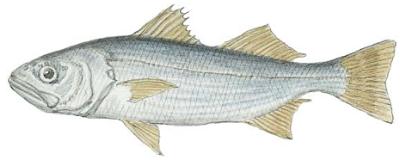
This abundant, small member of the Sparidae family is important as forage for predatory species of fish and is widely used by anglers as bait. There was once a fairly good commercial fishery for pinfish, but it is now a minor one; the flesh is oily and has a strong flavor.
Pinfish (Lagodon rhomboides)
This abundant, small member of the Sparidae family is important as forage for predatory species of fish and is widely used by anglers as bait. There was once a fairly good commercial fishery for pinfish, but it is now a minor one; the flesh is oily and has a strong flavor.
loading...
Pollock (Pollachius virens)
A member of the Gadidae family, the pollock is the most active of the various codfish and has been popular with anglers. It is an important commercial species, taken primarily by trawls and gillnets, and not to be confused with another cod family member, the Alaska, or walleye, pollock (Theragra calcogramma). A similar species sought by anglers is the European pollack (Pollachius pollachius).
Identification
The pollock is olive green to greenish-brown on top and yellowish-gray on the sides and the belly, with silvery overtones. It can be distinguished from other members of the cod family, such as the Atlantic cod, the haddock, and the tomcod, by three features: The lower jaw of the pollock projects beyond the upper jaw, the tail is forked, and the lateral line is quite straight, not arching above the pectoral fins.loading...
African Pompano (Alectis ciliaris)
The African pompano is the largest and most widespread member of the Carangidae family of jacks and pompano, surrounded by a great deal of confusion because until recently, adults and young were classified as entirely different species. A strong fighter and an excellent light-tackle gamefish, it is a superb food fish and is marketed fresh or salted/dried.
Identification
The most striking characteristic of the African pompano is the four to six elongated, threadlike filaments that extend from the front part of the second dorsal and the anal fins. These filaments tend to disappear or erode as the fish grows.loading...
Florida Pompano (Trachinotus carolinus)
A member of the Carangidae family of jacks and pompanos, the Florida pompano is an excellent gamefish for its size and is an exciting catch on light tackle. It is also considered a gourmet food fish because of its delicately flavored and finely textured meat.
Identification
Mostly silvery when alive, the Florida pompano is one of the few fish that is more striking in color after death. It then has greenish-gray or dark blue shading on the back and a golden cast to the belly and the fins. Deep- or dark-water fish tend to also have gold on the throats and on the pelvic and the anal fins; young fish tend to have yellowish bellies, anal fins, and tails.loading...
Porgies
The Sparidae family of porgies comprise roughly 112 species, and as a group they have worldwide distribution in the tropical and temperate waters of the Atlantic, the Pacific, and the Indian Oceans, although a few range into cooler waters.
Porgies are similar to grunts, but their bodies are even more flattened from side to side, or compressed, and high through the area just in front of the dorsal fins. As in some grunts, a porgy’s eyes are located high on the head and just behind the posterior margin of the mouth. The second, or soft, dorsal fin and the anal fin are both large and are about the same shape.
loading...
Jolthead Porgy (Calamus bajonado)
A member of the Sparidae family, which includes about 112 species, the jolthead is an excellent food fish with some commercial value and a species that bottom-probing anglers often encounter along the eastern United States; it has been associated with ciguatera, however. The common name presumably comes from the fish’s habit of using its head to bump or jolt clams or other mollusks loose from their attachments.
Identification
The high, rounded forehead gives the body a distinctive profile, typical of the genus. It eyes are large and are located high on the head. Yellowish-brown, with an almost metallic luster, it may be blotched with dusky splotches or nearly solid in color, depending on the bottom over which it is swimming. Some individuals are grayish. Over each eye is a blue streak, and sometimes there are faint blue lengthwise stripes on the body. The caudal fin is lunate (crescent-shaped).loading...
Queenfish (Croaker)
The queenfish is a small croaker and a member of the Sciaenidae family (drum and croaker). Essentially a panfish-size bottom scrounger, it is not an esteemed sport or food fish, but it is commonly caught from Pacific coast piers and may be desirable as whole or cut bait for other species.
Identification
The queenfish has an elongated, moderately compressed body. The upper profile is depressed over the eyes, and it has a large mouth. Its coloring is bluish above and becomes silvery below. The fins are yellowish. This species is distinguished from other croaker by its large mouth; by the base of its second dorsal and anal fins, which are roughly equal; and by the wide space between its two dorsal fins. There is no chin barbel on the lower jaw.loading...
Subscribe to:
Posts (Atom)