Showing posts with label gar. Show all posts

Alligator Gar (Lepisosteus spatula)

Alligator Gar (Lepisosteus spatula)

The alligator gar is the largest member of the gar family, Lepisosteidae, and one of North America’s largest inland fish. It is a primitive species, dating from the Mesozoic era, 65 to 230 million years ago. Fossil remains of gar are often found in limestone quarries throughout the southern United States. The tough, armorlike scales of this species were once used by Indians as arrowheads, and pioneer farmers covered their wooden plowshares with gar hides.

The gar is a resilient fish with an adaptable specialized air bladder that enables it to take in air at the surface, allowing it to survive in the poorest water conditions. Holding a strong resemblance to its namesake, the alligator gar is strong and voracious, and a tough fighter when hooked. It is capable of jumping spectacularly.

loading...

Florida Gar (Lepisosteus platyrhincus)

Florida Gar (Lepisosteus platyrhincus)

The Florida gar is a member of the Lepisosteidae family, an ancient group of predaceous fish once in abundance and widely distributed. Its specialized air bladder enables the gar to take in air at the surface, allowing it to survive in the poorest waters. Although edible, Florida gar are unpopular as food. They are caught by anglers, although not extensively pursued. The roe is highly toxic to humans, animals, and birds.

Identification

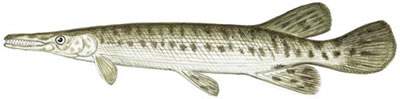
The body of the Florida gar is cigar-shaped, and it has a broad, tooth-filled snout. The single dorsal fin is located directly above the anal fin. Its tough scales form a bricklike pattern. Like the spotted gar, it has spots on top of the head, as well as over the entire body and on all the fins. These spots sometimes run together to form stripes.

loading...

Longnose Gar (Lepisosteus osseus)


The longnose gar is the most common and widely distributed member of the gar family, Lepisosteidae, one of the few remaining ancient groups of predaceous fish once in abundance. Its long endurance is due to a specialized air bladder that enables the gar to take in air at the surface, allowing it to survive in the poorest waters.

Identification

The body of the longnose gar is long and slender. It has an extended narrow beak (18 to 20 times as long as it is wide at its narrowest point). The skeleton is part cartilage and part bone. Both upper and lower jaws are lined with strong, sharp teeth. The nostrils are located in a small, bulbous, fleshy growth at the very tip of the beak.

loading...

Shortnose Gar (Lepisosteus platostomus)


The shortnose gar is the smallest member of an ancient family, Lepisosteidae, of predaceous fish. It is the most tolerant of all the gar, as it is capable of withstanding murky and brackish water with the help of its specialized air bladder. The bladder allows the gar to gulp in supplementary air and to release gases.

Because large numbers of coarse fish and panfish exist in many waters inhabited by gar, the shortnose gar (as well as other gar) can be useful in controlling these populations. In some areas, however, it is considered a nuisance by anglers and sometimes even a problem because of its abundance.

loading...

Spotted Gar (Lepisosteus oculatus)

Spotted Gar (Lepisosteus oculatus)

The spotted gar is a member of an ancient family, Lepisosteidae, of predaceous fish. It is often confused with its close relative, the Florida gar. The spotted gar has good sporting virtues but is not widely pursued, and it is often caught incidental to other fishing activities. It is not considered a good food fish, and its roe is toxic to humans but not to other fish.

Identification

The body of the spotted gar is long and cylindrical, covered with hard, ganoid (diamond-shaped) scales. It has a single row of teeth in each jaw. The spotted and the Florida gar are the only two gar that have spots on the top of the head, as well as over the entire body and on the fins.

loading...