Bumper

Bumper

The Atlantic and the Pacific bumper are two of the smaller members of the jack family. Both species have not been greatly studied, and there is some speculation that they may be the same.

Identification

Although the bumper doesn’t have a high back, it has an extended belly and a very thin body. With an overall silvery coloring, it has greenish tints on the back and yellow highlights on the sides and the belly. It also has a yellowish tail. There is a black spot on each gill cover and a black saddle on the base of the tail.

loading...

Butterfish (Peprilus triacanthus)

Butterfish (Peprilus triacanthus)

The fatty and oily quality of the meat of the butterfish does not detract from its reputation as an excellent food fish. It is sold fresh, smoked, and frozen and may be prepared in many ways; the meat is white, tender, and moist and contains few bones. The fat content of the flesh varies greatly over time, at its minimum in August and its maximum in November.

Despite its culinary significance, the butterfish’s importance to anglers is as a live or a dead bait for larger saltwater gamefish and as natural forage for assorted species. The shape of the butterfish resembles that of some members of the jack family.

loading...

Capelin (Mallotus villosus)

Capelin (Mallotus villosus)

A member of the smelt family, the capelin is an important food fish for cod, pollock, salmon, seabirds, and whales. It has commercial value; females are prized for their roe, and the meat is used as animal feed and fish meal. Like other smelt in flavor and texture, it is an excellent table fish, marketed canned and frozen and prepared by frying and dry salting.

Identification

The capelin has a large mouth with a lower jaw that extends below each eye. Males have larger and deeper bodies than do females; also, the male has an anal fin with a strongly convex base, whereas the female has a straight anal fin base. Both sexes possess a single dorsal fin and extremely small scales. The body is mostly silver, and the upper back is a darker bluish-green.

loading...

Gafftopsail Catfish (Bagre marinus)

Gafftopsail Catfish (Bagre marinus)

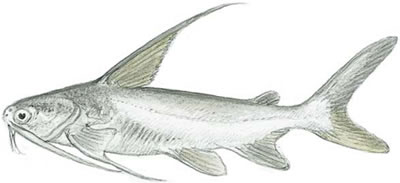
This sea catfish is a common catch by both commercial fishermen and recreational anglers in the Gulf Coast, especially between April and August. Its dark, tender, lean meat is popular as table fare and has a moderate flavor. Identification. The gafftopsail catfish has a steel-blue dorsal fin, silvery ventral fins, and a robust body, with a depressed broad head, featuring a few flattened barbels. The dorsal and the pectoral fins have greatly elongated spines.

Size/Age

Mature gafftopsails grow to 36 inches and 10 pounds. Average small fish weigh less than a pound to 1.5 pounds and are 17 inches long. The maximum age is unknown.

loading...

Bermuda Chub (Kyphosus sectatrix)

Bermuda Chub (Kyphosus sectatrix)

A member of the Kyphosidae family of sea chub, the Bermuda chub is a commonly encountered species, although not one that is aggressively sought by anglers. It is often caught in clear-water harbors and around reefs. Most individuals are reportedly good table fare, but their flesh spoils quickly and should be eaten soon after capture.

Identification

The Bermuda chub has an ovate profile, with a short head and a small mouth. A yellow stripe, bordered in white, runs from the edge of the mouth to the edge of the gill cover. The body is compressed and generally steel or blue-gray with muted yellowish stripes. The fins are dusky, the tail forked, and the scales are usually edged with blue. It may occasionally have white spots or blotches. A less common, very similar, but larger-growing relative is the yellow chub (K. incisor).

loading...

Cobia (Rachycentron canadum)

Cobia (Rachycentron canadum)

The only member of the Rachycentridae family, and with no known relatives, the cobia is in a class by itself and a popular food and sportfish for inshore anglers in areas where it is prominent.

Identification

The body of a cobia is elongated, with a broad, depressed head. The first dorsal fin consists of 8 to 10 short, depressible spines that are not connected by a membrane. Both the second dorsal fin and the anal fin each have 1 to 2 spines and 20 to 30 soft rays. The adult cobia is dark brown with a whitish underside and is marked on the sides by silver or bronze lines. A cobia’s shape is comparable to that of a shark, with a powerful tail fin and the elevated anterior portion of the second dorsal fin. It can be distinguished from the similar remora (Remora remora) by the absence of a suction pad on the head.

loading...

Atlantic Cod (Gadus morhua)

Atlantic Cod (Gadus morhua)

The Atlantic cod has historically been one of the world’s important natural resources, and the waters of the North Atlantic once teemed with this fish. Today, the commercial catch of cod is far below historic levels, and cod are generally in a collapsed or near-collapsed condition.

Identification

The Atlantic cod has three dark dorsal fins and two dark anal fins, none of which contain any spines. The body is heavy and tapered, with a prominent chin barbel, a large mouth, and many small teeth. Its snout is rounded on top, and the tail is almost squared. There is a characteristic pale lateral line. The coloring is highly variable on the back and the sides (ranging from brownish or sandy to gray, yellow, reddish, greenish, or any combination of these colors), gray-white on the underside, and with numerous light spots covering the body.

loading...