Showing posts with label mackerel. Show all posts

Atlantic Mackerel (Scomber scombrus)

Atlantic Mackerel (Scomber scombrus)

Like other members of the Scombridae family, the Atlantic mackerel is a fast-swimming, schooling, pelagic species that garners significant recreational and commercial interest. Sometimes it is almost completely absent, and at other times it is plentiful in swarming schools.

Identification

The Atlantic mackerel has a smooth, tapering head, a streamlined body, and brilliant coloration. An iridescent greenish-blue covers most of the upper body, turning to blue-black on the head and silvery white on the belly. The skin is satiny and has small, smooth scales.

loading...

Cero Mackerel (Scomberomorus regalis)

Cero Mackerel (Scomberomorus regalis)

A popular gamefish in tropical waters and a member of the Scombridae family, the cero mackerel is a pelagic species that also has commercial interest. It is considered excellent table fare and is marketed fresh, smoked, and frozen. Off-shore anglers may use the cero mackerel as rigged bait for larger predatory species.

Identification

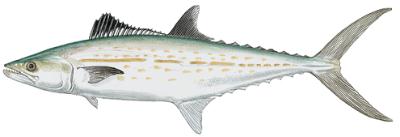
The cero mackerel is iridescent bluish-green above and silvery below, with rows of short, yellow-brown spots above; there are also yellow-orange streaks and a dark stripe below, which runs the length of the body from the pectoral fin to the base of the tail. The front of the first dorsal fin is bluish-black and has 17 to 18 spines and 15 to 18 gill rakers on the first arch. The pectoral fins are covered with small scales. The cero mackerel differs from the king mackerel and the Spanish mackerel in the pattern of its spots, which are rather elongated and arranged in lines instead of being scattered; the cero mackerel also has a lateral line that curves evenly down to the base of the tail, which further distinguishes it.

loading...

Frigate Mackerel (Auxis thazard)

Frigate Mackerel (Auxis thazard)

Frigate mackerel are an abundant member of the Scombridae family and hold an important place in the food web, especially as a forage fish for other species. They are commercially significant and marketed fresh, frozen, dried/salted, smoked, and canned.

Identification

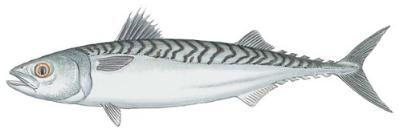
The color of the frigate mackerel is dark greenish-blue above and silvery white below. It has 15 or more narrow, oblique, dark wavy markings on the unscaled back portion of its body. There are eight dorsal finlets and seven anal finlets. It resembles the tuna family more than it does the mackerel, with its more lunate than forked tail; as with all mackerel, however, its first and second dorsal fins are separated by a wide space.

loading...

King Mackerel (Scomberomorus cavalla)

King Mackerel (Scomberomorus cavalla)

The largest mackerel in the western Atlantic, the king mackerel is a prized gamefish and an important commercial species, with millions of pounds of fish landed annually. A member of the Scombridae family, the king mackerel has firm meat, most of which is sold fresh or processed into steaks. Smaller quantities are canned, salted, smoked, and frozen. It may be ciguatoxic in certain areas, however.

Identification

The streamlined body of the king mackerel is a dark gray above, growing silver on the sides and below, and there are no markings on the body, although the back may have an iridescent blue to olive tint. Most of the fins are pale or dusky, except the first dorsal fin, which is uniformly blue; the front part of this fin is never black, which distinguishes it from the Spanish mackerel and the cero mackerel.
loading...

Pacific Jack Mackerel (Trachurus symmetricus)

Pacific Jack Mackerel (Trachurus symmetricus)

Not a true mackerel but a member of the Carangidae family of jacks, the Pacific jack mackerel is marketed fresh, smoked, canned, and frozen.

Identification

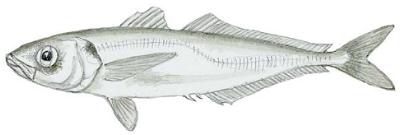
The body of the Pacific jack mackerel is somewhat compressed and elongate, with a tail that is as broad as it is deep. It is metallic blue to olive green on the back, shading to silver on the belly. Its last dorsal and anal soft rays are attached to the body or rarely separated from the fins, and the sides are covered with enlarged scales. The Pacific jack mackerel bears a resemblance to the Mexican scad, but the enlarged scales distinguish it, as do the last, attached rays of the dorsal and the anal fins. On the Mexican scad, the rays are isolated finlets.

loading...

Pacific Sierra Mackerel (Scomberomorus sierra)

Pacific Sierra Mackerel (Scomberomorus sierra)

The Pacific sierra mackerel is an abundant fish in the Pacific along the coasts of Mexico and Central America. A member of the Scombridae family of mackerel and not to be confused with the Atlantic sierra (Scomberomorus brasiliensis), which occurs only in the Atlantic, the Pacific sierra mackerel is an eastern Pacific fish that is excellent to eat.

It is marketed fresh and frozen. It resembles the Spanish mackerel in appearance, and the all-tackle world record is an Ecuadorian fish of 18 pounds caught in 1990.


Pacific sierra mackerel extend from La Jolla in Southern California south to the Galápagos Islands and to Paita, Peru. They have recently been reported from Antofagasta, Chile. A schooling species, Pacific sierra mackerel are found in surface coastal waters and over the bottom of the continental shelf. Thought to spawn close to the coast, they feed on small fish, especially anchovies.

Other Names

Pacific sierra; Spanish: macarela, serrucho, sierra, verle.
loading...

Spanish Mackerel (Scomberomorus maculatus)

Spanish Mackerel (Scomberomorus maculatus)

The Spanish mackerel is a popular gamefish and a good food fish of the Scombridae family.

Identification

The slender, elongated body of the Spanish mackerel is silvery with a bluish or olive-green back. There are 16 to 18 spines in the first dorsal fin, 15 to 18 soft rays in the second dorsal fin—with 8 to 9 finlets behind it, and 13 to 15 gill rakers on the first arch. The lateral line curves evenly downward to the base of the tail.

loading...