Showing posts with label bass. Show all posts

Florida Largemouth Bass (Micropterus salmoides floridanus)


The Florida largemouth bass, also known as the Florida bass, is a subspecies of the largemouth bass, which in turn is often called a northern largemouth. This fish occurs naturally in Florida. Mixtures of it and northern largemouth are called intergrades, as they are neither pure Florida nor pure northern strains. These fish occur from northern Florida to Maryland.

Florida bass grow to trophy size more readily than do northern largemouth bass. They have been stocked in many states, including California, which has produced near–world record 22-pounders from transplanted stocks, and in Texas, which has completely transformed its big-bass potential by stocking this fish.
loading...

Guadalupe Bass (Micropterus punctulatus)


The Guadalupe bass is a member of the Centrarchidae family and is similar to the spotted bass (see: Bass, Spotted) in appearance. It has 10 to 12 dark bars along its sides, which are less distinct in older fish; it usually has 16 pectoral rays and 26 to 27 scales around the caudal peduncle. It can grow to almost 16 inches and usually weighs less than a pound. The all-tackle world record is a 3-pound, 11-ounce Texas fish taken in 1983.

In North America, Guadalupe bass are restricted to the Edwards Plateau in the Brazos, Colorado, Guadalupe, San Antonio, and upper Nueces (where introduced) River drainages in southern Texas. They occur in gravel riffles, runs, and flowing pools of creeks, as well as in small to medium rivers.
loading...

Largemouth Bass (Micropterus salmoides)


The largemouth bass is the biggest and most renowned member of the Centrarchidae family of sunfish and its subgroup known as black bass. It is sometimes confused with the smallmouth in places where both species occur, and also with the spotted bass (see: Bass, Spotted). One subspecies, the Florida largemouth bass (see: Bass, Florida Largemouth), M. salmoides floridanus, is capable of attaining large sizes in appropriate waters but is otherwise similar.

Identification

The largemouth bass has an elongated and robust shape compared to other members of the sunfish family. It has a distinctively large mouth, as the end of its maxillary (jaw) falls below or beyond the rear margin of the eye; the dorsal fin has a deep notch separating the spiny and soft rays; and the tail is broad and slightly forked.

loading...

Peacock Bass


Peacock bass are among the world’s hardest-fighting freshwater fish. They willingly take lures, strike hard, and provide a strong and exciting battle.

The term “peacock bass” is a misnomer, but it is a name that has good marketing value and one that has stuck in the English-speaking world. Species that are called peacock bass in English are formally known as pavón in Spanish-speaking countries and as tucunaré in Brazil.

loading...

Redeye Bass (Micropterus coosae)

Redeye Bass (Micropterus coosae)

There are two widely recognized forms of this member of the black bass group of the Centrarchidae family: the Apalachicola, which is called a shoal bass, and the Alabama, which is generally referred to as the redeye bass or the true redeye.

The shoal bass has yet to be described fully or given a distinct scientific name, and there is some confusion over the two. A scrappy fighter, the redeye bass often jumps when hooked and is hard to catch. Its white, flaky meat is of good table quality, similar to that of other black bass.

loading...

Roanoke Bass (Ambloplites cavifrons)

Roanoke Bass (Ambloplites cavifrons)

The Roanoke bass is a sunfish and a member of the Centrarchidae family, similar in body shape to a rock bass (see: Bass, Rock) or warmouth (see). It can be identified by its unscaled or partly scaled cheek and the several iridescent gold to white spots on its upper side and head. It is olive to tan above, has a dark and light marbling on the sides, and often sports rows of black spots and a white to bronze breast and belly.

It is also distinguished by the 39 to 49 lateral scales, 11 anal rays, and 27 to 35 scale rows across its breast between the pectoral fins. The all-tackle world record is a 1-pound, 5-ounce fish taken in Virginia in 1991. Growing to a maximum of 14.5 inches, the Roanoke

loading...

Rock Bass (Ambloplites rupestris)

Rock Bass (Ambloplites rupestris)

The rock bass is actually a member of the sunfish family and is not a true bass. Rock bass are fun to catch because they can be caught on many types of baits and lures, and they put up a decent fight on ultralight tackle. Rock bass are known to overpopulate small lakes, making population control measures necessary.

Identification

Although it looks like a cross between a bluegill and a black bass, the rock bass is actually a large and robust sunfish with a deep body; it is less compressed than most sunfish and is more similar to a black bass in shape. The back is raised, and the large head is narrow, rounded, and deep.

loading...

Smallmouth Bass (Micropterus dolomieui)

Smallmouth Bass (Micropterus dolomieui)

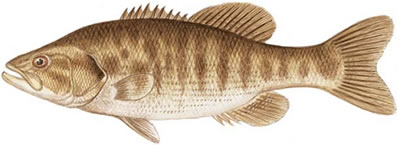
The smallmouth bass is the second largest member of the Centrarchidae family of sunfish and a North American original. To anglers, it is one of the most impressive of all freshwater fish and is coveted for its fighting ability.

The smallmouth is not actually a bass but a sunfish, and its mouth is only small in comparison to that of some relatives. It is naturally a fish of both clear rivers and lakes and has been widely introduced to other waters outside its original range.

loading...

Spotted Bass (Micropterus punctulatus)

Spotted Bass (Micropterus punctulatus)

Often mistaken by anglers for the largemouth bass, the spotted bass is a lesser-known member of the black bass group of the Centrarchidae family than either the largemouth or the smallmouth, but this is a spunky and distinguished-looking species that no angler is unhappy about catching, even if most are encountered by accident.

The general term “spotted bass” really incorporates three recognized subspecies: the northern spotted bass (M. p. punctulatus), the Alabama spotted bass (M. p. henshalli), and the Wichita spotted bass (M. p. wichitae); the last was previously thought to be extinct and is still rarely encountered.

loading...

Suwannee Bass (Micropterus notius)

Suwannee Bass (Micropterus notius)

The Suwannee bass is similar in bodily appearance to the smallmouth bass and in markings to the redeye bass, except that it is generally brown overall, and the cheeks, breasts, and bellies of large males are bright turquoise.

It, too, has a large mouth, with the upper jaw extending under the eye, and possesses a patch of teeth on the tongue, a spot at the base of the tail, and blotches on the sides. It is further identified by its 59 to 64 lateral scales, 16 pectoral fin rays, 12 to 13 dorsal fin rays, and 10 to 11 anal fin rays.

loading...

White Bass (Morone chrysops)

White Bass (Morone chrysops)

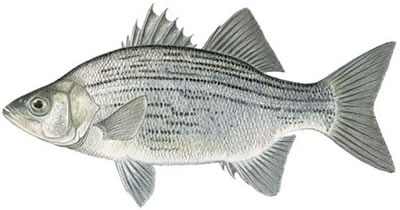
A member of the temperate bass family, the white bass is a freshwater fish known for its spunky fighting ability, as well as its merits as an excellent eating fish. Because of its small size, it is often considered a panfish. White bass usually travel in schools and can provide a lot of action, making them highly desirable among light-tackle enthusiasts and for fishing with family and youths.

Identification

The white bass has a moderately deep and compressed body that is raised behind the small head and the large mouth, deepest between the two dorsal fins. It also has 11 to 13 rays on the anal fin and one to two patches of teeth at the back of the tongue. The coloration is mostly silvery with a dark grayish green on the back and anywhere from 4 to 10 dark horizontal stripes running along the sides. It also has yellow eyes, clear to dusky dorsal and caudal fins, and clear to white pectoral and pelvic fins.

loading...

Whiterock Bass (Morone saxatilis x Morone chrysops)

Whiterock Bass (Morone saxatilis x Morone chrysops)

Hybrid striped bass have become one of the most popular introduced fish in freshwater. Hybrid stripers are the progeny of one pure-strain striped bass parent and one purestrain white bass parent. When the cross is between the female striper and the male white bass, the result is primarily known as a whiterock bass; in some places it is referred to as a wiper and in some simply as a hybrid striped bass. When the cross is between the male striper and the female white bass, it is called a sunshine bass (primarily in Florida) or simply a hybrid striped bass.

These fish, which usually look like stockier versions of pure-strain stripers, are aggressive and hard-fighting fish that provide great sport. The fact that they are so strong and grow fairly large rather quickly endears them to anglers, not to mention that they can be a more ambitious lure and bait consumer than pure stripers.

loading...

Yellow Bass (Morone mississippiensis)

Yellow Bass

A popular light-tackle quarry and usually lumped into the category of panfish, the yellow bass is a scrappy fighter and provides good sport on light tackle. With white, flaky flesh, it is also a good food fish, on a par with or exceeding white bass and compared by some to the yellow perch.

Many anglers are unfamiliar with this member of the temperate bass family because it is largely restricted to the middle portion of the United States and is smaller than its relatives; a true bass, the yellow is related to the striped bass, the white bass, and the white perch.

loading...

Striped Bass (Morone saxatilis)

Striped Bass (Morone saxatilis)

An excellent sportfish that attains large sizes, the striped bass is a member of the temperate bass family (often erroneously placed with the sea bass family). It has been considered one of the most valuable and popular fish in North America since the early 1600s, originally for its commercial importance and culinary quality and in more recent times for its recreational significance.

Identification

A large fish with a large mouth, the striped bass is more streamlined than its close relative the white bass. It has a long body and a long head, a somewhat laterally compressed body form, and a protruding lower jaw. Of the two noticeably separate dorsal fins, the first one has 7 to 12 stiff spines, usually 9, which make this fin quite a bit higher than the second; the second dorsal fin has one sharp spine and 8 to 14, ordinarily 12, soft rays. The striped bass also has a forked tail and small eyes.

loading...