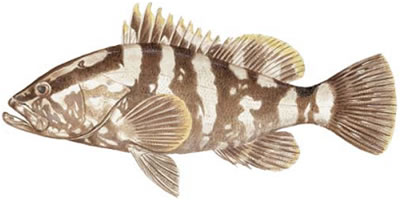
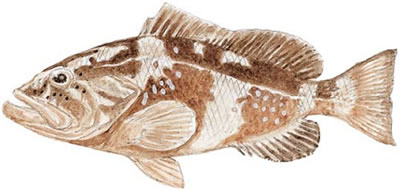
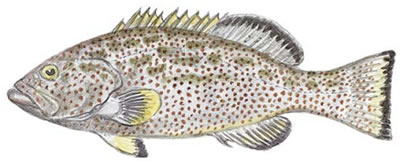
The black grouper is a fairly large and hard-fighting member of the Serranidae family. It is an excellent food fish, although the flesh is occasionally toxic and can cause ciguatera.
Showing posts with label grouper. Show all posts
Black Grouper (Mycteroperca bonaci)
The black grouper is a fairly large and hard-fighting member of the Serranidae family. It is an excellent food fish, although the flesh is occasionally toxic and can cause ciguatera.
loading...
Goliath Grouper (Epinephelus itajara)
The largest grouper and a member of the Serranidae family, the goliath grouper is an important gamefish and an excellent food fish.
Identification
The goliath grouper is yellowish-brown to olive green or brown. Dark brown blotches and blackish spots mottle the entire body, including the head and the fins; these markings are variable and are more prominent on the young. Irregular dark bands run vertically along the sides, although these are usually obscure.loading...
Nassau Grouper (Epinephelus striatus)
The most important commercial grouper in the West Indies and a member of the Serranidae family, the Nassau grouper has been very heavily fished and is continually vulnerable to overfishing, especially during its spawning and migrating seasons.
Identification
Although its color pattern varies, the Nassau grouper usually has a light background, with a wide, dark brown stripe running from the tip of the snout through each eye to the start of the dorsal fin, as well as four to five irregular dark bars running vertically along the sides.loading...
Red Grouper (Epinephelus morio)
The red grouper was one of the most abundant grouper in the Caribbean and surrounding waters until spearfishing and general overfishing depleted its numbers.
Identification
Of varying coloration, the red grouper is usually dark brownish-red, especially around the mouth, and may have dark bars and blotches similar to those on the Nassau grouper, as well as a few small whitish blotches scattered in an irregular pattern. It is distinguished from the Nassau grouper by its lack of a saddle spot and its smooth, straight front dorsal fin.loading...
Warsaw Grouper (Epinephelus nigritus)
The warsaw grouper is one of the largest members of the Serranidae family of grouper and sea bass, second only to the goliath grouper in size. It has white, flaky meat that is marketed fresh. It is more widespread than the goliath grouper and caught more frequently.
Identification
The warsaw grouper has a gray-brown or dark red-brown body, occasionally irregularly spotted with several small, white blotches on the sides and the dorsal fins, although these are indiscernible in death. The young warsaw has a yellow tail and a dark saddle on the caudal peduncle. The warsaw is distinctive as the only grouper with 10 dorsal spines, the second of which is much longer than the third. It also has a squared-off tail. In contrast to the goliath grouper, the rays of the first dorsal fin on the warsaw grouper are much higher and the head is much larger.loading...
Yellowfin Grouper (Mycteroperca venenosa)
The scientific name of this member of the Serranidae family means “venomous,” a reference to the yellowfin grouper’s association with ciguatera poisoning. Despite this, its flesh is good to eat and is usually considered safe for commercial sale.
Identification
The yellowfin grouper has highly variable coloring, usually with a pale background and horizontal rows of darker, rectangular blotches covering the entire fish; the ends of these blotches are rounded, and they can be black, gray, brown, olive green, or red.loading...
Subscribe to:
Posts (Atom)