Showing posts with label trout. Show all posts

Apache Trout (Oncorhynchus apache)

Apache Trout (Oncorhynchus apache)

A member of the Salmonidae family, the Apache trout is Arizona’s state fish and was once so abundant that early pioneers caught and salted large numbers of them as a winter meat source. Since those times, a 95-percent reduction in range has resulted from hybridization with rainbow trout, brook trout, and other trout. The Apache trout was among the first fish species protected when the Endangered Species Act of 1973 was enacted, and it is currently listed as “threatened” or “likely to become endangered in the near future.”

Identification

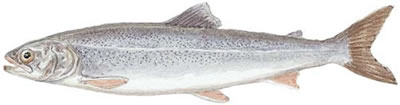
The Apache trout is a striking fish, with yellow to golden sides, an adipose fin, and a large dark spot behind each eye. The head, the back, the sides, and the fins have evenly spaced dark spots, and the dorsal, the pelvic, and the anal fins are white tipped. The underside of the head is orange to yellowish-orange, with a complete lateral line of 112 to 124 scales.

loading...

Blueback Trout (Salvelinus alpinus oquassa)

Blueback Trout (Salvelinus alpinus oquassa)

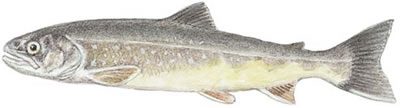
This member of the charr family was once classified as a separate species, with the scientific name Salvelinus oquassa. A landlocked, or nonanadromous, charr, it was reclassified as a subspecies of the arctic charr (S. alpinus oquassa), along with its close relatives the Sunapee trout and the Quebec red trout. The blueback trout of Rangeley Lakes, Maine, were once extremely abundant but are now extinct; however, bluebacks are abundant in a few other waters of this state, and there is open-water fishing for them.
loading...

Brook Trout (Salvelinus fontinalis)

Brook Trout (Salvelinus fontinalis)

Brook trout are technically not true trout but are closely related to trout; they are charr and members of a family composed of lake trout, bull trout, bluebacked trout, Dolly Varden, and arctic charr. As a native North American fish, and a sensitive one that has been displaced in some habitats as the result of fish stocking or water degradation, the brook trout has long been a favorite of stream and pond anglers, especially in the northeastern region of North America.

Identification

Brook trout have a coloration and patterns so unique that there is seldom any confusion with other fish, especially when one is looking at a native specimen (which will be richer and more brightly marked and colored than a hatchery specimen). Three external features allow immediate separation of the brook trout from either the brown or the rainbow trout or other charr. White pipings on the outer edges of all but the caudal (tail) fin identify it as a charr.

loading...

Brown Trout (Salmo trutta)

Brown Trout (Salmo trutta)

One of the most adaptable members of the Salmonidae family, the brown trout was the first species of trout described by Linnaeus, the father of modern taxonomy.

The species called Salmo trutta (meaning, respectively, “salmon” and “trout”) is the backbone of natural and hatchery-maintained trout fisheries on six continents and is one of the world’s premier sportfish, but it takes on many forms—river, lake, and sea-run—in many diverse environments, and is greatly varied in its appearance.

loading...

Cutthroat Trout (Oncorhynchus clarki)

Cutthroat Trout (Oncorhynchus clarki)

The term “cutthroat throat” and its scientific designation O. clarki—the species name in honor of Captain Clark of the Lewis and Clark expedition—is more like a name for a family tree than for a single species of fish.

According to some scientific estimates, there are 14 subspecies, hybrids, and variations, forming what has been called an ichthyological jigsaw puzzle of fish that are endemic to western North America. All of these are members of the Salmonidae family of salmon, trout, whitefish, and grayling, and were reclassified from the trout genus Salmo to the Pacific salmon genus Oncorhynchus.

loading...

Gila Trout (Oncorhynchus gilae)

Gila Trout (Oncorhynchus gilae)

Along with the Apache trout (see: Trout, Apache), the Gila is one of two native trout in Arizona, both severely threatened. Because of interbreeding with rainbow trout (see: Rainbow Trout) and a similarity in appearance to cutthroat trout (see: Trout, Cutthroat), it wasn’t identified as a separate species until 1950.

A member of the Salmonidae family, the Gila trout is an olive-yellow to brassy fish, with small irregular black spots across its upper body, head, and dorsal and caudal fins. These markings protect the fish from predators.

loading...

Golden Trout (Oncorhynchus aguabonita)

Golden Trout (Oncorhynchus aguabonita)

California’s state fish, the golden trout is classified as two recognizable subspecies, O. aguabonita aguabonita of California’s South Fork of the Kern River and Golden Trout Creek, and O. aguabonita gilberti of the main Kern and the Little Kern Rivers; an area of warm water where the South Fork joins the Kern apparently serves as a natural barrier separating the two subspecies.

Identification

The golden trout is considered one of the most beautiful of freshwater gamefish because of its striking coloration and markings; it has a bright red to red-orange belly and cheeks, with golden lower sides, a red-orange lateral streak, and a deep olive-green back.

loading...

Lake Trout (Salvelinus namaycush)

Lake Trout (Salvelinus namaycush)

The lake trout is one of the largest members of the Salmonidae family, which encompasses salmon, trout, charr, and whitefish. This fish is not actually a “trout” but a charr, and thus a close relative of the brook trout and the arctic charr.

The lake trout was once associated with many variations, some of which have been termed subspecies or strains; some of these no longer exist, and others are deep dwellers that are not commonly known to anglers.

loading...

Rainbow Trout (Oncorhynchus mykiss)

Rainbow Trout (Oncorhynchus mykiss)

The rainbow trout is one of the most widely distributed freshwater fish and the one member of the Salmonidae family that presently has global distribution. Endemic to western North America, it was reclassified from the trout genus Salmo to the Pacific salmon genus Oncorhynchus (it was formerly identified as Salmo gairdneri) and occurs in both freshwater resident and anadromous, or sea-run, races (see: Steelhead).

One landlocked variety of rainbow trout from the interior of British Columbia is called the Kamloops trout, a genetically large strain called Gerrard trout exists in British Columbia’s Kootenay Lake and its Lardeau River tributary, and there are many other variations (as well as hatchery-created hybrids) of rainbows known.

loading...

Sunapee Trout (Salvelinus alpinus oquassa)

Sunapee Trout (Salvelinus alpinus oquassa)

This member of the charr family was once classified as a separate species with the scientific name Salvelinus aureolus. A landlocked, or nonanadromous, charr, it was reclassified as a subspecies of the arctic charr (S. alpinus oquassa; see: Charr, Arctic), along with its close relatives the blueback trout and the Quebec red trout.

The common name is derived from a native population of Sunapee Lake in New Hampshire; Sunapee trout there hybridized with lake trout and are no longer believed to exist, and the species is not currently documented in that state. Sunapees do exist in Maine, where there is a remnant population in Flood’s Pond, and reintroductions have been made into some other waters.
loading...

Trout-Perch (Percopsis omiscomaycus)

Trout-Perch (Percopsis omiscomaycus)

A member of the small Percopsidae family, the confusingly named trout-perch is neither a trout nor a perch, nor is it of angling significance, although it is an important forage species for predators.

Identification

The trout-perch derives its name from a superficial resemblance to a trout, by virtue of having an adipose fin, and to a yellow perch or a juvenile walleye by its body configuration. It has a fairly deep cylindrical body with a narrow caudal peduncle, large eyes, and a large unscaled head that is flattened on the underside.

loading...