The summer flounder, most commonly called fluke, is a member of the Bothidae family of flatfish, or left-eyed flounder. Fishing for summer flounder off jetties and bridges is a mainstay of mid-Atlantic coastal sportfishing.
Summer Flounder (Paralichthys dentatus)
The summer flounder, most commonly called fluke, is a member of the Bothidae family of flatfish, or left-eyed flounder. Fishing for summer flounder off jetties and bridges is a mainstay of mid-Atlantic coastal sportfishing.
loading...
Winter Flounder (Pseudopleuronectes americanus)
One of the most common and well-known flounder of shallow Atlantic coastal waters, the winter flounder belongs to the Pleuronectidae family of flatfish. It is a right-eyed flat-fish, with both eyes on the right side of its body, and gets its name because it retreats to cold, deep water in the summer and reappears in shallower water close to shore in the winter; its relative the summer flounder does the opposite.
Identification
The body is oval and flat with a tiny mouth. Color varies from reddish-brown to dark brown with small black spots. The underside is whitish and occasionally brown, tinged with blue around the edges. The caudal fin is slightly rounded. The winter flounder differs from the similar yellowtail flounder in its straight lateral line, no arch over the pectoral fin, thicker body, and widely spaced eyes.loading...
Flyingfish
Flyingfish are members of the Exocoetidae family and are closely related to halfbeaks, balao, and needlefish. The flyingfish has normal-length jaws, unlike these other species; the fins are soft rayed and spineless; and the lateral line is extremely low, following the outline of the belly.
The dorsal and anal fins are set far back on the body. The pectoral fins of flyingfish are greatly expanded, forming winglike structures. The round eggs are generally equipped with tufts of long filaments that help to anchor the eggs in seaweeds.
loading...
Gag (Mycteroperca microlepis)
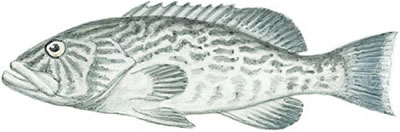
Gags belong to the branch of the grouper family that is characterized by a long, compressed body and 11 to 14 rays in the anal fin. Gags have white, flaky flesh that makes excellent eating, although, like other grouper, they have deeply embedded scales that are virtually impossible to remove.
Identification
Pale to dark gray or sometimes olive gray, the larger gag is darker than the smaller gag and has blotchy markings on its side and an overall indistinctly marbled appearance. The smaller gag is paler and has many dark brown or charcoal marks along its sides. The pelvic, the anal, and the caudal fins are blackish, with blue or white edges. The gag is distinguished from the black grouper by its deeply notched preopercles and is distinguished from the otherwise similar scamp by the absence of extended caudal rays.loading...
Goosefish
The goosefish has been described as mostly mouth with a tail attached. A member of the Lophiidae family of deep-sea anglerfish, this ugly, bottom-dwelling species of temperate waters is not a targeted gamefish but is occasionally caught by deep-water bottom anglers. More than two dozen species of anglerfish exist worldwide, with the American goosefish the largest among them.
Identification
The American goosefish is dark brown, with a mottling of dark spots and blotches. It has almost armlike pectoral fins located about midway in its greatly flattened body. Small gill openings are just behind them. The head is extremely large for its body size, and the mouth is cavernous, filled with sharp, curved teeth and opening upward.loading...
Graysby (Cephalopholis cruentata)
A member of the grouper/seabass family, the graysby is a small, secretive reef fish. Graysby are commonly caught on hook and line, but their small size precludes them from being particularly sought after.
Identification
Varying from pale gray to dark brown, the graysby has many darker orangish, red-brown spots on its body, fins, and chin. There are three to five distinctive marks, like pale or dark spots, that run along the base of the dorsal fin. A white line runs between the eyes from the nape to the lower lip.loading...
Black Grouper (Mycteroperca bonaci)
The black grouper is a fairly large and hard-fighting member of the Serranidae family. It is an excellent food fish, although the flesh is occasionally toxic and can cause ciguatera.
Identification
Depending on location, the black grouper may be olive, gray, or reddish-brown to black. It has black, almost rectangular blotches and brassy spots. It can pale or darken until its markings are hardly noticeable.loading...
Subscribe to:
Posts (Atom)